The Backbone of the Battlefield: Understanding High-Capacity Radio Relay Communications
The Backbone of the Battlefield: Understanding High-Capacity Radio Relay Communications
In modern warfare, communication is the lifeblood of tactical and strategic operations. Without robust, secure, and instantaneous data transfer, even the most advanced military forces risk operational paralysis. The modern battlefield demands the continuous exchange of voice, high-definition video, targeting data, and C4ISR (Command, Control, Communications, Computers, Intelligence, Surveillance, and Reconnaissance) information. This is where High-Capacity Radio Relay (HCRR) systems, operating across designated NATO bands, become the true backbone of the battlefield.
Behind these complex communication networks are the hardware systems that make transmission possible. Designing the critical points of transmission and reception requires extreme precision, and facilities in the Delhi NCR, India region have become crucial hubs for engineering these highly specialized military, aerospace, marine, and aviation antenna systems.
What Are NATO Band Radio Relays?
A radio relay system provides secure point-to-point and point-to-multipoint connections between military IP routers, command centers, and legacy communications systems. By operating across designated NATO spectrums (for instance, NATO Band I cover 225-400 MHz, NATO Band II spans 610–960 MHz, NATO Band III covers 1350-1850 MHz, NATO Band III+ covers 1350-2700 MHz, and NATO Band IV spans 4400-5000 MHz), these systems avoid civilian interference and are standardized to ensure interoperability between allied nations. These high-capacity links act as the bridge over which the bulk of a military’s data is carried when satellite bandwidth is unavailable, delayed, or actively jammed by an adversary.
What is High Capacity Radio Relay?
At its core, a radio relay system uses a series of high-performance antennas to transmit and receive high-frequency radio waves (usually in the microwave spectrum) across a line-of-sight path. Unlike traditional omnidirectional broadcasting that scatters signals in all directions, radio relay focuses the signal into a tight, highly directional beam. This concentrated energy minimizes signal loss, increases security by making the signal harder to intercept, and—most importantly—allows for high capacity data transfer that rivals physical fiber connections.
Decoding NATO Frequency Bands for High-Capacity Radio Relay
Military radio frequency allocations are strictly managed to avoid interference, ensure security, and optimize data throughput over varying distances. NATO bands dictate the spectrum utilized for these HCRR networks. Below is a detailed comparison of the primary frequency bands and features utilized in military High-Capacity Radio Relay:
| NATO Band Designation | Frequency Range | Key Characteristics | Typical Battlefield Applications |
|---|---|---|---|
| NATO Band I | 225 - 400 MHz | Exceptional penetration through foliage and terrain; non-line-of-sight (NLOS) capabilities. | Tactical ground-to-air, squad-level comms, and foliage-heavy terrain links. |
| NATO Band II | 610 – 960 MHz | Good foliage penetration with partial NLOS capabilities; offers slightly higher bandwidth than Band I. | Tactical trunk networks and ground-level relays where terrain obstacles prevent perfect line-of-sight. |
| NATO Band III | 1350 - 1850 MHz | Balanced blend of range and capacity. Good resilience against atmospheric attenuation. | Mid-tier backhaul, brigade-level mobile command posts, and naval comms. |
| NATO Band III+ | 1350 – 2700 MHz | Extended bandwidth across L and lower S bands for significantly higher data rates; strict LOS required. | Advanced IP-based tactical networks needing wideband channels for secure data and voice multiplexing. |
| NATO Band IV | 4400 - 5000 MHz | Exceptionally high data rates (up to 100 Mbps+). Requires Line-of-Sight (LOS). | High-Capacity Radio Relay (HCRR), long-range backhaul, base-to-base trunk links. |
| NATO Band V | 7100 - 8500 MHz | Ultra-high capacity; highly directional narrow beams ensuring extreme security. | Point-to-point strategic links, satellite uplink/downlink, and theater command backhaul. |
Important Technical Parameters of HCRR Antennas
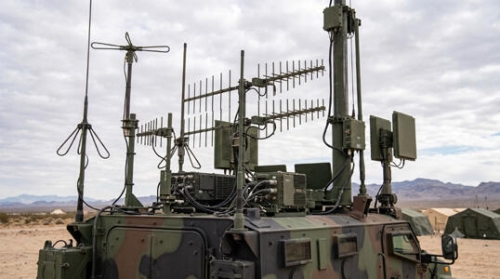
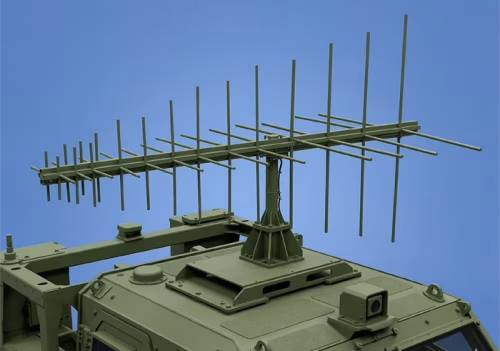
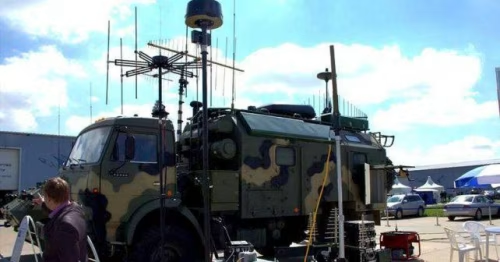
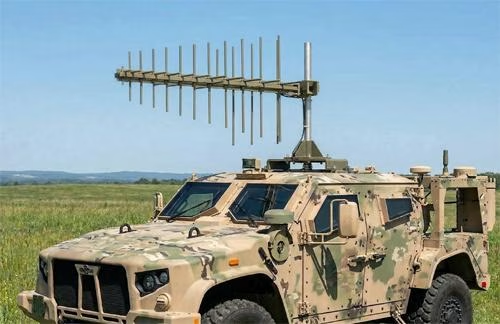
To meet the rigorous demands of the modern war-fighter, HCRR networks rely on highly engineered antenna arrays—such as advanced log-periodic, discone, helical, yagi, collinear, and stacked dipole configurations. These must adhere to stringent specifications:
- Frequency Agility & Hopping: Systems must support rapid Frequency Hopping Spread Spectrum (FHSS) to counter Electronic Counter-Measures (ECM) and jamming attempts.
- Data Throughput: Capability to handle scalable transmission capacities from 2 Mbps up to 100 Mbps (using CPM, 16 QAM, or 64 QAM modulation).
- Adaptive Power Control (APC): Automated adjustment of transmission power to minimize the likelihood of interception and detection.
- Beamforming & High Gain: Utilizing precisely engineered multi-element arrays to create narrow, high-gain transmission beams over 25 kilometers.
- Forward Error Correction (FEC): Ensuring data integrity and minimizing packet loss even in environments with high signal-to-noise interference.
- Environmental Camouflage: Tactical arrays are treated with specialized visual and radar-absorbent coatings, strictly finished in matte olive green, sand yellow, or desert tan to blend seamlessly into operational theaters.
Key Applications in the HCRR Antennas Field
Military tactical radio relay systems utilize specific NATO frequency bands often based on EUROCOM standards to balance range, signal penetration, and data throughput. High-Capacity Radio Relay (HCRR) systems typically operate in the higher frequency tiers, such as Band IV and Band III+ to achieve the wide bandwidths necessary for high-speed battlefield network backhaul. The deployment of HCRR systems and specialized military antennas serves several critical mission parameters:
- Secure Line-of-Sight (LOS) Backhaul: Establishing high-bandwidth trunk lines between forward operating bases (FOBs) and rear command echelons.
- Offensive & Flexible Battlefield Environments: Rapid deployment of mobile command centers requiring instant high-speed data access without relying on vulnerable fiber-optic cables.
- C4ISR Data Transfer: Transmitting real-time high-definition drone feeds, radar telemetry, and geospatial intelligence across high-altitude and rugged terrains.
- Naval & Aerospace Integration: Linking marine vessels and aviation assets into a unified tactical network using omnidirectional discone and high-gain helical arrays.
- Rapid Deployment: When disaster strikes or a military unit needs to establish a command center, waiting weeks to lay fiber isn't an option. Radio relay antennas can be set up in hours.
- Cost-Effective Backhaul: Expanding networks across mountains, rivers, or dense urban infrastructure is vastly cheaper when transmitting through the air instead of the ground.
- Low Latency: Radio waves travel through the air faster than light travels through fiber-optic glass, giving radio relay a slight latency advantage for mission-critical operations.
The Role of Antenna Experts: Uncompromising Quality and Compliance
The effectiveness of any HCRR network is fundamentally limited by the quality of its antennas. Antenna Experts has established itself as a premier manufacturer in this highly specialized field, producing aerospace, marine, military, and aviation antenna systems engineered to perform when failure is not an option.
Operating out of a state-of-the-art facility in New Delhi NCR, India, Antenna Experts ensures that every piece of hardware is built to survive the harshest environments on the planet. Their commitment to battlefield reliability is reflected in their extensive list of compliances and certifications:
- MIL-STD-810G Compliance: Rigorously tested against military standards for extreme temperatures, shock, vibration, humidity, salt fog, and explosive decompression.
- NATO Cage Code: Officially recognized and registered within the NATO codification system, streamlining procurement for allied defense forces globally.
- Nato Stock Number (NSN): Products are assigned NSNs, verifying their integration into defense logistics systems and military supply chains.
- EU & CE Directives: Fully compliant with European Union safety, health, and environmental protection requirements for electronic and telecommunication equipment.
- ISO Certification: Manufactured under strict ISO 9001 certified quality management systems, ensuring consistent, defect-free production across all product lines.
In an era where spectrum dominance equates to battlefield supremacy, the combination of advanced NATO band HCRR networks and the rugged, precision-engineered solutions from Antenna Experts ensures that military forces remain connected, informed, and ready to act.
The Hardware: Durability Meets Precision
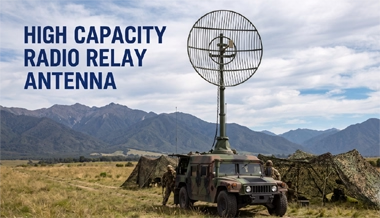
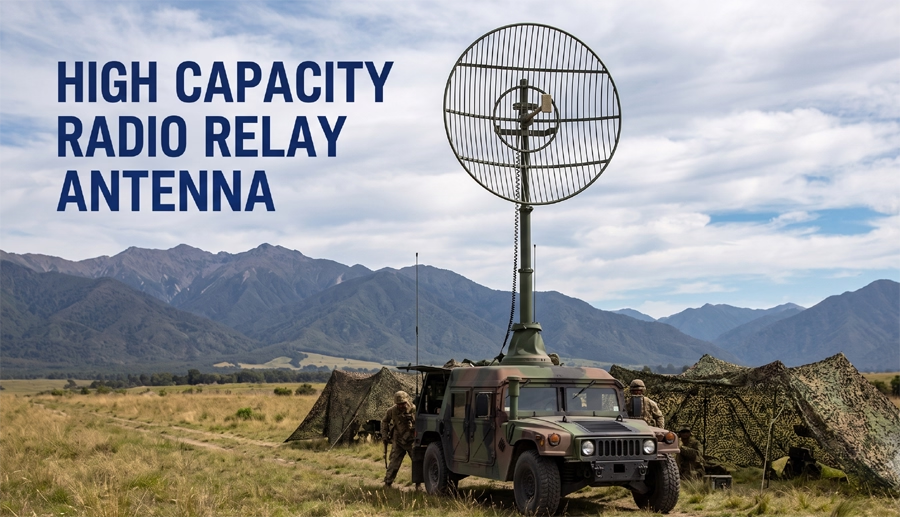
To achieve highly directional, secure, and broad-bandwidth communication, specialized equipment is required. The antennas used must survive the harshest environments on earth while maintaining pinpoint accuracy. Antenna Experts Tactical High Capacity Radio Relays Grid Parabolic Antenna Complied the following MIL-STD Environmental Specifications:
- High Temperature: MIL-STD-810G, Method 500.5, Procedures I and II (Operational: +70°C and Storage: +70°C)
- Low Temperature: MIL-STD-810G, Method 502.5, Procedures I and II (Operational: -30°C and Storage: -40°C)
- Low Pressure (Altitude): MIL-STD-810G, Method 500.5, Procedures I and II
- Vibration: MIL-STD-810G, Method 514.6, Procedure I Table 514.6C-VI, Category 4
- Shock: MIL-STD-810G, Method 516.6, Procedure IV
- Rain: MIL-STD-810G, Method 506.5, Procedure I
- Humidity: MIL-STD-810G, Method 507.5, Procedures I and II
- Fungus Resistance: MIL-STD-810G, Method 508.6
- Salt Fog: MIL-STD-810G, Method 509.5
Why MIL-STD Compliance Matters for High Capacity Terrestrial Links
When setting up high-speed terrestrial data links for military operations, the physical hardware is just as critical as the RF engineering. True tactical radio relay systems must guarantee continuous uptime regardless of the weather—from severe salt fog on coastal deployments to drastic temperature swings at high altitudes. By leveraging NATO Band compatibility alongside meticulous mechanical design (like the type 316 marine grade stainless steel hardware and ABS-sealed radomes), modern tactical arrays ensure rapid deployment (under 5 minutes) and zero downtime when communication matters most.
Band IV Features Utilized in High-Capacity Radio Relay (HCRR)
Modern military HCRR systems, typically operating in Band IV (4.4 – 5.0 GHz) or Band III+, are designed to establish secure, fiber-like backbone connectivity across hostile environments. To achieve this, they incorporate several advanced RF and networking features:
- Electronic Counter-Countermeasures: Systems employ rapid frequency hopping across their wide operational bands to avoid interception and mitigate active enemy jamming attempts.
- Adaptive Power Control: Transceivers dynamically adjust their output power based on real-time link conditions. This maintains link stability during atmospheric fading while minimizing the radio footprint to lower the Probability of Intercept (LPI/LPD).
- Adaptive Modulation and Coding: Links seamlessly shift between complex modulation schemes (like 64-QAM for maximum throughput) down to robust schemes (like QPSK or CPM) during heavy interference or adverse weather conditions to prevent link failure.
- Forward Error Correction: Heavy data interleaving and advanced coding algorithms are applied to mathematically rebuild lost data packets, ensuring data integrity over degraded RF channels.
- Full-Duplex Communication: Operating primarily through Frequency Division Duplexing (FDD), these links transmit and receive simultaneously, allowing for ultra-low latency backhaul that supports voice, video, and data multiplexing.
- Flexible Architectures: Baseband indoor units (IDUs) offer multi-interface support (Ethernet, E1/E3) and the transceivers can be configured for both Point-to-Point (PTP) and Point-to-Multi-Point (PTMP) network topologies for rapid battlefield deployments.
Looking Forward
As the digitized battlefield expands to include swarm drones, mesh network topologies, and AI-driven defense mechanisms, the demand placed on the tactical network will only increase. By utilizing heavily protected NATO frequency bands paired with ruggedized, high-gain parabolic antenna infrastructure, allied forces ensure they are never disconnected when it matters most.
The Future of Wireless Backhaul
As we push deeper into the eras of 5G, IoT (Internet of Things), and automated logistics, the invisible infrastructure in our skies will become even more critical. High capacity radio relay communication will continue to serve as the backbone that bridges the gaps where cables simply cannot go, ensuring that whether in a bustling metropolis or a remote tactical outpost, the connection remains strong.