How Antennas Power SIGINT Operations
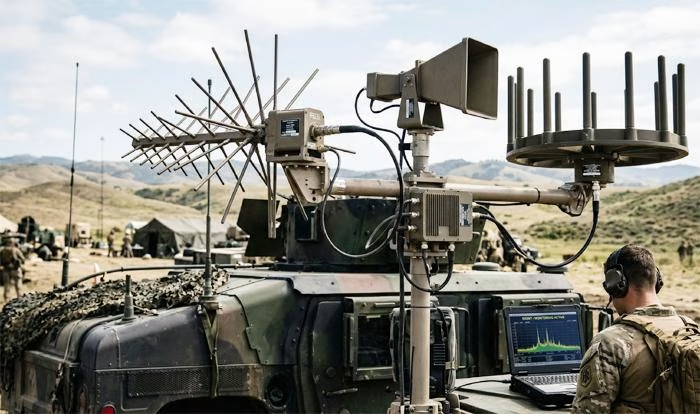
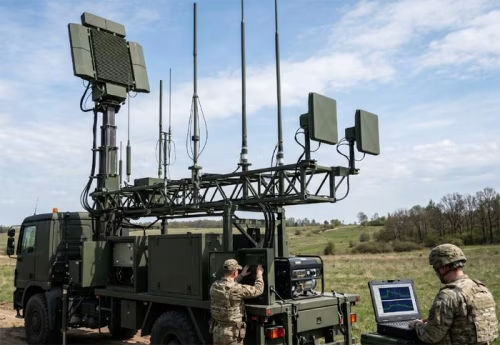
In the world of modern electronic warfare, Information is the ultimate high ground. Signals Intelligence (SIGINT) is the practice of intercepting, identifying, and analyzing electronic signals to gain a tactical or strategic advantage. At the very heart of this process lies a critical, often overlooked component: The Antenna.
Without high-performance antennas, the most sophisticated software-defined radios and decoders would be deaf to the electromagnetic spectrum. Here is how antennas function as the "ears" of SIGINT operations.
1. Interception: Capturing the Invisible
The primary role of an antenna in SIGINT is to convert passing electromagnetic waves—from radio broadcasts to encrypted radar pulses—into electrical signals.
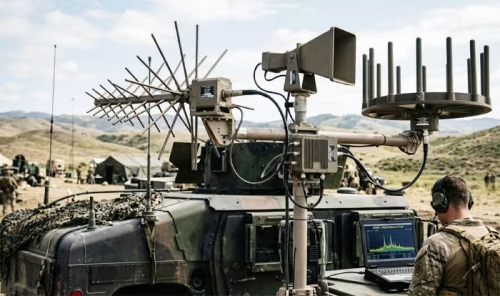
Unlike standard communication antennas designed for a single frequency (like your car radio), SIGINT antennas must often be Wideband or Ultra-Wideband. They are designed to "listen" across a massive range of frequencies simultaneously to ensure no critical data packet or frequency-hopping signal goes unnoticed.
2. Direction Finding (DF) and Geolocation
Knowing what was said is important, but knowing where it came from is vital. SIGINT operations utilize specialized antenna arrays to pinpoint the physical location of a transmitter.
- Direction Finding (DF): By using multiple antennas in a fixed array, systems can calculate the Angle of Arrival (AoA). By measuring the slight delay (phase difference) of the signal hitting each antenna, the system can determine the precise bearing of the enemy's radio.
- Triangulation: By using two or more DF stations separated by a distance, operators can cross-reference bearings to find the exact coordinates of the target.
3. Monitoring the "Invisible" Spectrum
SIGINT is broadly divided into two categories, both of which rely on specialized antenna hardware:
- COMINT (Communications Intelligence): Focuses on intercepting human-to-human speech, text, and data. Antennas for COMINT are often optimized for HF, VHF, and UHF bands where tactical radios operate.
- ELINT (Electronic Intelligence): Focuses on non-communication signals, primarily Radar. ELINT antennas are often high-gain, directional "dishes" or horn antennas designed to pick up high-frequency pulses from surface-to-air missile batteries or naval vessels.
4. Ruggedization for the Field
SIGINT isn't just done from climate-controlled bunkers; it happens on the front lines. Antennas used in these operations are built to survive extreme conditions.
- Tactical Man-Packable: Foldable or telescopic antennas used by ground troops.
- Vehicle-Mounted: Ruggedized whips or low-profile "shark fin" antennas that can withstand high speeds and vibration.
- Airborne/UAV: Streamlined, aerodynamic antennas mounted on drones or surveillance aircraft to provide a "bird's eye view" of the electronic battlefield.
Summary Table: SIGINT Antenna Types
| Antenna Type | Primary Use Case | Key Advantage |
|---|---|---|
| Log-Periodic | Wideband Monitoring | High gain across a wide frequency range. |
| Adcock Array | Direction Finding | Excellent for locating tactical VHF/UHF radios. |
| Spiral Antennas | ELINT / Radar | Wide bandwidth and circular polarization for missile detection. |
| Grid/Dish Antennas | Long-Range Intercept | Maximum gain for picking up weak, distant signals. |
The Strategic Edge
In a world where every military asset—from a tank to a handheld radio—emits electronic "noise," the antenna is the filter that turns that noise into actionable intelligence. By choosing the right frequency coverage, gain, and polarization, SIGINT operators can map the enemy’s movements without ever firing a single shot.