Why Fiberglass Collinear Antennas Dominate Base Stations
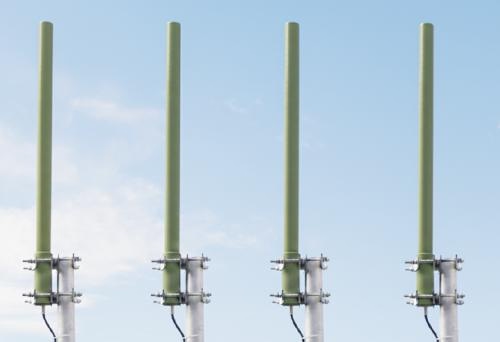
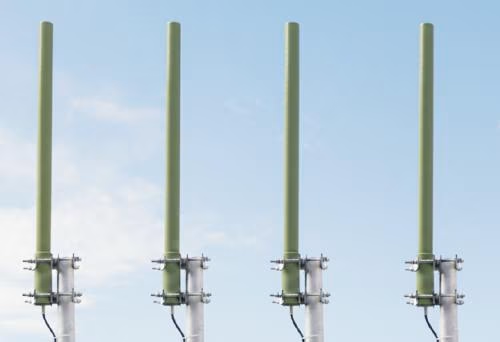
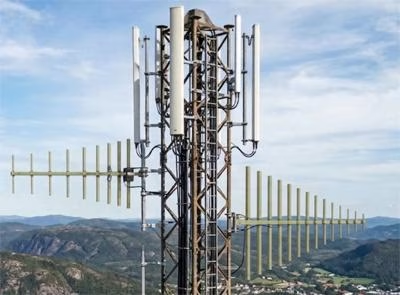
If you’ve ever looked at a cellular tower or a radio mast, you’ve likely seen them: long, slender white or gray poles pointing toward the sky. These aren't just structural supports; they are Fiberglass Collinear Antennas.
In an era of satellite links and complex phased arrays, this classic design remains the backbone of land mobile radio (LMR), specialized mobile radio (SMR), and many cellular base stations.
1. The Power of "Stacking": Vertical Directivity
The word collinear simply means "in a straight line." These antennas consist of multiple dipole elements stacked vertically inside a single housing.
- The Physics: By arranging elements this way and feeding them in-phase, the antenna "flattens" the signal. Instead of wasting energy by radiating it into space (up) or into the ground (down), a collinear array pushes the energy outward toward the horizon.
- Super High Gain: This stacking effect creates massive passive gain. Without needing more electricity, the antenna concentrates the signal into a disc-like pattern that reaches significantly further than a standard antenna.
2. 360-Degree "Omni" Coverage
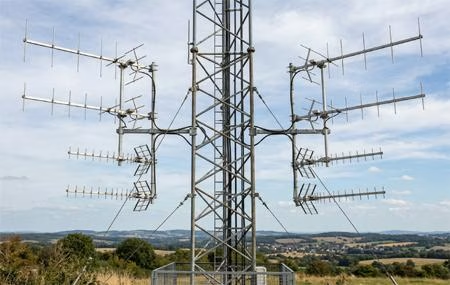
Most base stations need to serve users in every direction simultaneously. Unlike Yagi antennas (which are directional like a flashlight) or Panel antennas (which cover a 120° sector), the collinear array is omnidirectional.
It provides a perfect 360-degree horizontal radiation pattern. For a city’s emergency services or a local carrier, this means one single mounting point can provide a "blanket" of coverage for the entire surrounding area.
3. The "Fiberglass" Advantage: The Radome
You might wonder why these antennas are encased in a thick fiberglass tube (the radome). It isn't just for aesthetics; it’s a masterclass in material science.
- RF Transparency: Fiberglass is "invisible" to radio waves. It allows the signal to pass through with almost zero loss or distortion.
- Environmental Armored Shell: Base stations are exposed to the worst of nature—UV radiation, ice, saltwater spray, and high winds. Fiberglass doesn't rust like metal or degrade like many plastics.
- Wind Loading: The cylindrical shape of the fiberglass housing is aerodynamic, reducing the "wind load" on the tower. This allows for taller masts without the risk of the structure buckling during a storm.
4. Lightning and Static Protection
Base stations are literally lightning rods. Most high-quality fiberglass collinear antennas are designed with DC Grounding.
Inside the fiberglass, the radiating elements are often electrically connected to the metal mounting base. This creates a path for static buildup and lightning strikes to travel safely to the ground system, protecting the sensitive (and expensive) radio equipment inside the base station shelter.
Summary: Efficiency Meets Durability
The dominance of the fiberglass collinear array comes down to a perfect marriage of geometry and material. It offers the highest possible gain for 360-degree coverage while being rugged enough to survive decades on a mountaintop.
| Feature | Benefit to Base Station |
|---|---|
| Collinear Stacking | Flattens the signal to the horizon for maximum range. |
| Omnidirectional | Connects users in all directions from one pole. |
| Fiberglass Radome | Protects internal elements from corrosion and wind. |
| DC Grounding | Safeguards expensive hardware from electrical surges. |