Signal Jamming vs. Spoofing - The Technical Divide in RF and Cybersecurity
Signal Jamming vs. Spoofing : The Technical Divide in RF and Cybersecurity
In the landscape of modern cybersecurity and Electronic Warfare (EW), Radio Frequency (RF) attacks have transitioned from military-exclusive threats to mainstream commercial vulnerabilities. As global infrastructure becomes increasingly reliant on autonomous systems, IoT devices, and Global Navigation Satellite Systems (GNSS) like GPS, securing the airwaves is no longer optional.
Two terms frequently dominate this conversation: Jamming and Spoofing. While both aim to disrupt communication and navigation systems, their methodologies, complexities, and impacts are fundamentally different. Here is a deep dive into the technical mechanics of jamming versus spoofing, how they exploit system architectures, and how engineers are defending against them.
RF Jamming (Denial of Service)
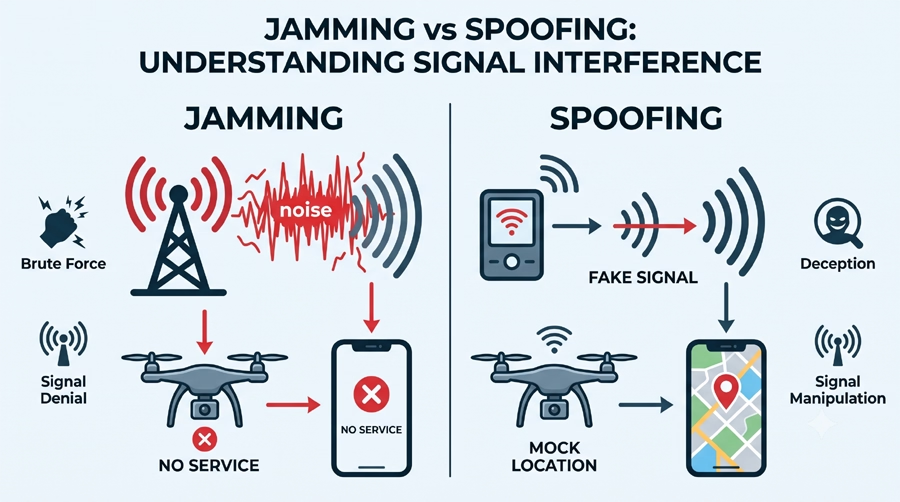
Jamming works by transmitting high-power radio frequency energy on the same frequencies used by a target receiver (like a radar array or a GNSS receiver).
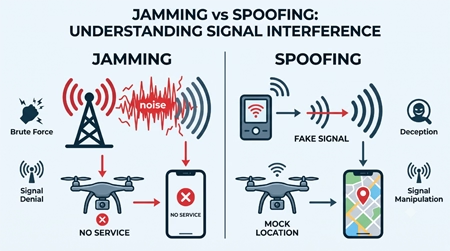
- The Mechanism: It aims to overwhelm a receiver with sheer RF noise, making the legitimate signal impossible to process. The system knows it is under attack or failing. The goal is to drastically lower the target's Signal-to-Noise Ratio (SNR). By raising the noise floor artificially, the jamming transmitter drowns out the weaker, authentic signal. It is the RF equivalent of shining a high-powered flashlight directly into a security camera.
- Detection: Jamming is usually easy to detect. The receiver will instantly register a massive, unnatural spike in RF energy and alert operators that the frequency is being contested or saturated.
- Result: The receiver loses its lock on the legitimate signal and cannot process any data.
RF Spoofing (Deception)
Spoofing is a much more sophisticated cyber-physical attack. Instead of blasting noise, the attacker transmits a highly structured, counterfeit signal designed to perfectly mimic the authentic signal.
- The Mechanism: It aims to trick the receiver into accepting false data as legitimate. The system does not know it is being manipulated. The spoofer generates a signal with the correct modulation, framing, and encryption (if compromised or bypassed). It transmits this fake signal at a power level just slightly higher than the authentic signal. The receiver's tracking loops are "captured" by the stronger fake signal, and it begins processing the manipulated data—such as false GPS coordinates or fake IFF (Identification Friend or Foe) returns.
- Detection: Spoofing is incredibly difficult to detect because the RF environment appears normal. There is no massive spike in noise; the receiver simply believes it is reading a strong, clean signal.
- Result: The receiver continues to operate normally but feeds false data to the system operators or flight computers.
The Core Difference: The "Noise" vs. The "Lie"
At a high level, the distinction between the two attacks comes down to their objective regarding the CIA triad (Confidentiality, Integrity, Availability):
In the context of radio frequency (RF) engineering, radar, and navigation systems, the difference comes down to denial versus deception.
Jamming is a brute-force attack designed to blind a receiver, while spoofing is a precise attack designed to trick it.
| Feature | Signal Jamming | Signal Spoofing |
|---|---|---|
| Attack Type | Denial of Service (DoS) / RF Interference | Deception / Data Integrity Attack |
| Mechanism | Floods the target frequency with high-power RF noise | Injects perfectly timed, counterfeit signal data |
| Target Awareness | High (The system alerts that the signal is lost) | Low (The system believes it is functioning normally) |
| Complexity | Low (Requires raw power) | High (Requires precise timing, location, and data replication) |
| Primary Goal | To blind or silence the target | To hijack, misdirect, or manipulate the target |
Deep Dive: How Signal Jamming Works
Jamming relies on the brute force of physics. Receivers (whether a cell phone, a drone's video feed, or a ship's GPS antenna) are tuned to listen to specific frequencies. A jammer transmits a high-power signal on that exact same frequency, effectively raising the "noise floor" until the Signal-to-Noise Ratio (SNR) degrades to the point where the receiver can no longer extract the data.
The GPS Jamming Problem
Jamming is highly effective against GNSS systems because legitimate satellite signals are incredibly weak by the time they reach Earth. GPS satellites orbit at roughly 20180 km, and their signals arrive at a receiver at a staggering -130 to -160 dBm watts per square meter). Because the baseline signal is so faint, an unauthorized 1 watt terrestrial transmitter can easily drown out GPS signals over a radius of several Kilometers.
Types of Jamming
- Spot Jamming: Focuses all power on a single, narrow frequency (e.g., GPS L1 at 1575.42 MHz & GPS L2 at 1227.60 MHz).
- Sweep Jamming: Rapidly sweeps power across a wide band of frequencies to disrupt multiple communication channels sequentially.
- Barrage Jamming: Broadcasts noise across a broad spectrum of frequencies simultaneously, requiring massive power output but effectively creating a total RF blackout in a region.
Deep Dive: How Signal Spoofing Works
Spoofing is a surgical operation. Instead of blinding the receiver, the attacker masquerades as the legitimate transmitter. The goal is to feed the target subtle lies, such as altering a ship's coordinates, shifting a drone's flight path, or modifying the timing data used to synchronize financial markets.
The Mechanics of Deception
To successfully spoof a GNSS receiver, an attacker uses Software-Defined Radios (SDR) and GNSS simulators to broadcast a counterfeit signal that identically matches the structure of the real satellite signal. The spoofer must factor in:
- The exact orbital data (ephemeris) of the satellites in view.
- The precise timing of the atomic clocks.
- Doppler shifts corresponding to the target's relative motion.
The attacker starts broadcasting the fake signal at a power level slightly higher than the real satellite signal. Once the target receiver "locks on" to the fake signal, the attacker can slowly alter the data to drift the receiver's calculated position away from reality.
Meaconing vs. Synthesized Spoofing
It is important to distinguish between two sub-types of spoofing:
- Meaconing: The attacker captures a legitimate GNSS signal using an antenna, delays it or amplifies it, and rebroadcasts it. This doesn't require generating complex code, but it simply forces the receiver to report the location of the capturing antenna rather than its own.
- Synthesized Spoofing: The attacker dynamically generates false GNSS signals from scratch, allowing them to dictate specific, fabricated coordinates and trajectories to the target.
Defending the Airwaves: Modern Mitigation Strategies
As both jamming and spoofing tools become cheaper and highly portable, defense mechanisms have had to evolve. Engineers deploy several layers of mitigation depending on the critical nature of the system:
- Controlled Reception Pattern Antennas (CRPA): These smart antennas use multiple elements to detect the direction an interfering signal is coming from. They can then dynamically create a "null" (a blind spot) in that specific direction, ignoring the jammer or spoofer while continuing to listen to legitimate satellites.
- Sensor Fusion & Inertial Fallbacks: Modern autonomous systems rarely rely on GPS alone. By combining GNSS data with Inertial Navigation Systems (INS)—which use internal accelerometers and gyroscopes—the system can detect if the GPS data suddenly defies the laws of physics (a common sign of spoofing) and navigate blindly without external RF input.
- Signal Encryption: Military GNSS utilizes encrypted bands (like GPS M-Code or L1/L2 P(Y)). Because the attacker does not hold the cryptographic keys, they cannot mathematically generate a valid counterfeit signal, rendering synthesized spoofing virtually impossible.
- Navigation Message Authentication (NMA): Newer civilian constellations (like Galileo) are introducing cryptographic watermarks to civilian signals, allowing receivers to verify that the data genuinely originated from a satellite.
Conclusion
While jamming is a loud, destructive force that severs connectivity, spoofing is a silent, insidious threat that manipulates trust. As our reliance on RF signals grows—from cellular networks to autonomous logistics—understanding the technical mechanics of how these systems can be overwhelmed or deceived is the first step in architecting resilient infrastructure. For critical systems, the mantra is clear: never trust a single source of navigational or timing data.