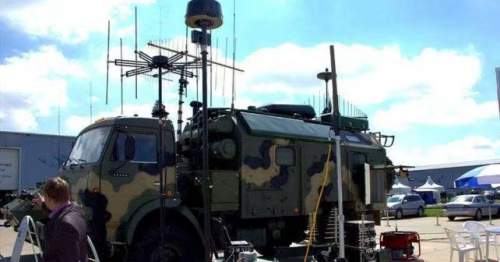
The Latest Innovations in Military Antennas
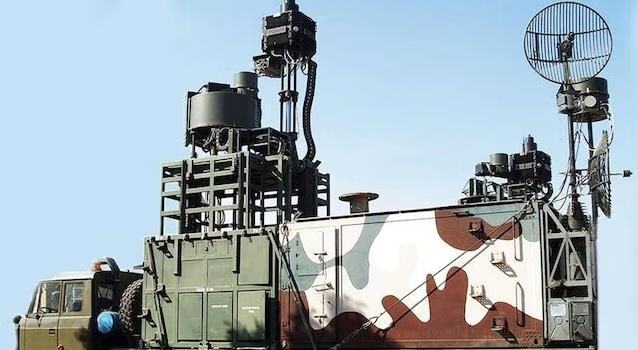
Elevating Defense Communications: The Latest Innovations in Military Antennas
In today’s digital battlefield, reliable and secure communication is not just an operational requirement—it is a matter of survival. As electronic warfare (EW) and signal intelligence (SIGINT) become increasingly complex, the demand for rugged, high-performance tactical equipment has never been higher.
At Antenna Experts, we specialize in designing and manufacturing premium military antennas that guarantee 100% connectivity, reliability, and rigidity in the most hostile environments. From ground-to-air links to naval shipboard installations, our tailor-made solutions are empowering armed forces and government agencies worldwide.
The Silent Vanguard: Dominating the Spectrum with EW and SIGINT Military Antennas
In modern conflict, the most fiercely contested battlespace is one you cannot see: the Electromagnetic Spectrum (EMS). As adversaries deploy increasingly sophisticated communication networks, radar installations, and remote-controlled threats, the ability to control this invisible domain is paramount.
This control is achieved through two distinct but deeply integrated disciplines: Electronic Warfare (EW) and Signals Intelligence (SIGINT). At the absolute heart of these operations—acting as the eyes, ears, and fists of the system—are high-performance military antennas.
Whether you are configuring a tactical vehicle, a naval vessel, or a manpack system, understanding the specific antenna requirements for EW and SIGINT is critical to mission success.
Understanding the Mission: SIGINT vs. EW
While they often utilize the same frequency bands and share hardware ecosystems, SIGINT and EW have different operational goals:
- SIGINT (Signals Intelligence): The art of quietly listening. SIGINT antennas intercept enemy communications (COMINT) and radar/electronic signals (ELINT). The goal is to detect, analyze, and geolocate the adversary without alerting them.
- EW (Electronic Warfare): The art of spectrum denial and protection. Once SIGINT identifies a threat, EW steps in to disrupt, deceive, or destroy the enemy's use of the spectrum. This includes jamming enemy communications, blinding radar, or disabling Radio-Controlled Improvised Explosive Devices (RCIEDs).
The Anatomy of a Mission-Critical Antenna
Off-the-shelf commercial antennas cannot survive the rigors—or meet the technical demands—of the digital battlefield. For an antenna to be viable in EW and SIGINT applications, it must possess specific characteristics:
1. Instantaneous Ultra-Wide Bandwidth In an EW scenario, the frequency of an incoming threat (like a frequency-hopping radio or an IED trigger) is often unknown. Antennas must cover massive frequency ranges (e.g., 20 MHz to 9000 MHz) instantaneously, without the need for mechanical or electrical tuning.
2. High Power Handling While SIGINT is passive (receive-only), EW active jamming requires blasting high-wattage RF energy (often 1KW or more) into the environment. The antenna must transmit this energy efficiently without overheating or degrading.
3. Polarization Agility Hostile signals can be transmitted in various orientations (vertical, horizontal, or circular). Dual-polarized antennas allow military forces to capture signals simultaneously across both E and H planes, ensuring no critical data is lost due to polarization mismatch.
Directional vs. Omnidirectional: Choosing the Right Tool
Deploying the right antenna geometry is the difference between neutralizing a threat and being overwhelmed by it.
Omnidirectional Antennas (The "Net")
When the direction of a threat is unknown, omnidirectional antennas provide a 360-degree blanket of coverage. They are essential for continuous spectrum monitoring, early warning systems, and protective "bubble" jamming around convoys.
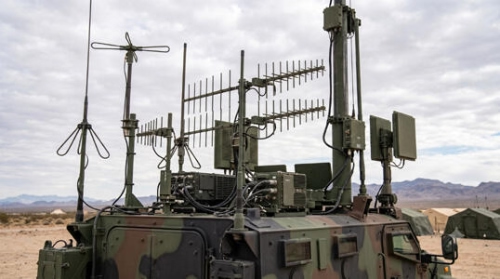
- Key Profiles: Wideband Discone antennas, HF Broadband Vertical Conical Monopoles, and Coaxial Dipoles.
Directional Antennas (The "Spear")
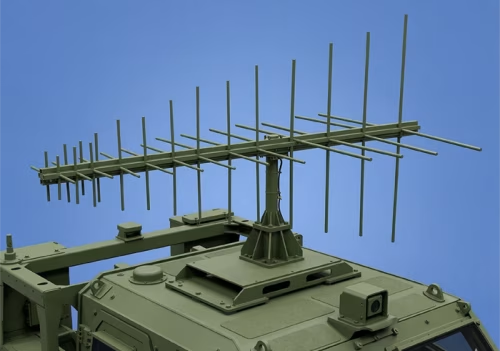
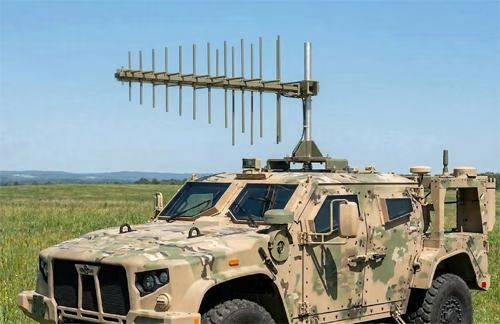
When a threat's location is known—or when trying to calculate its exact position using Angle of Arrival (AoA) Direction Finding—directional antennas are deployed. They focus their gain in a specific direction, allowing forces to listen to distant, faint signals or concentrate high-power jamming energy precisely where it hurts the enemy most.
- Key Profiles: Log Periodic Dipole Arrays (LPDAs), High Gain Horns, and Cavity-Backed Spirals.
Why Partner with Antenna Experts?
At Antenna Experts, we understand that in the theater of operations, equipment failure is not an option. We specialize in the design and manufacture of the world's highest-performing wideband antennas tailored specifically for Aerospace and Defense.
- Proven Reliability: Our products are ruggedized for extreme weather and hostile environments, fully compliant with MIL-STD requirements.
- Zero Defect Policy: Every antenna is 100% inspected and tested in-house at our state-of-the-art 20-meter Open Area Test Site before deployment.
- Custom Solutions & Shortest Lead Times: We know that emerging threats require rapid adaptation. We excel at designing bespoke, special-to-type antennas and delivering them with the industry's shortest turnaround times.
From compact tactical manpack antennas to massive naval shipboard arrays, Antenna Experts provides the reliable connectivity and spectrum dominance your forces require.