How To Choose Best TETRA Antenna
Choosing the right TETRA (Terrestrial Trunked Radio) antenna is a decision that impacts the safety and efficiency of mission-critical communications. Whether you are managing a public safety network, a transport hub, or a large industrial site, the antenna is the vital link between your radio and the network infrastructure.
1. Match the Frequency Band
TETRA operates on specific licensed bands that vary by region and organization. Selecting an antenna that isn't perfectly tuned to your assigned frequency will lead to high VSWR (Voltage Standing Wave Ratio), which can damage your radio and cause dropped calls.
- Public Safety: Usually operates in the 380–400 MHz or 410–430 MHz range.
- Commercial/Industrial: Often found in the 450–470 MHz or 806–870 MHz bands.
- Pro Tip: Look for "Full Band" or "Broadband" antennas (e.g., 380–470 MHz) if your operations span multiple frequency blocks or if you need flexibility in deployment.
2. Determine the Application Type
The "best" antenna depends entirely on where it will be installed.
| Application | Recommended Antenna Type | Key Benefit |
|---|---|---|
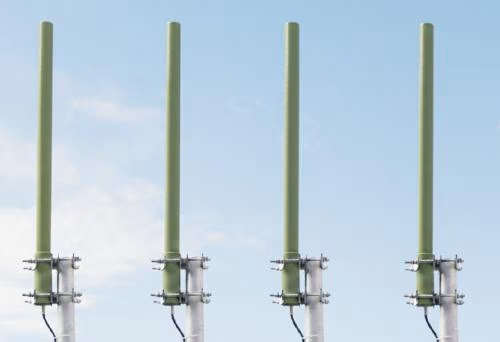
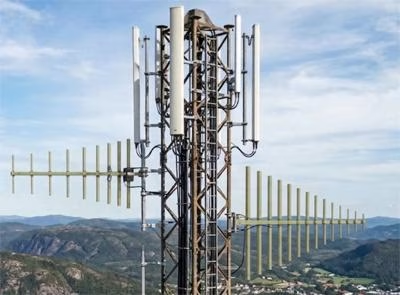
| Fixed Base Station | Collinear Omni or Stacked Dipole | High gain for maximum area coverage. |
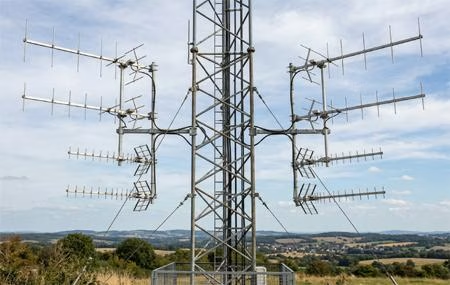
| Point-to-Point Link | Yagi or Log Periodic | Directional focus for long-distance connectivity. |
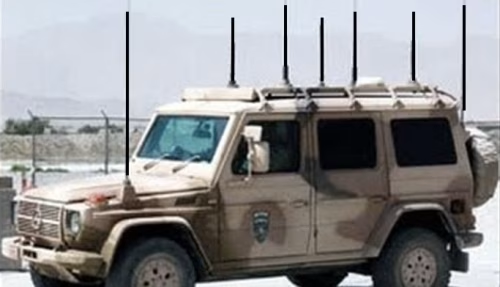
| Vehicle Mounted | Whip or Magnetic Mount | Ruggedness and low-profile for mobility. |
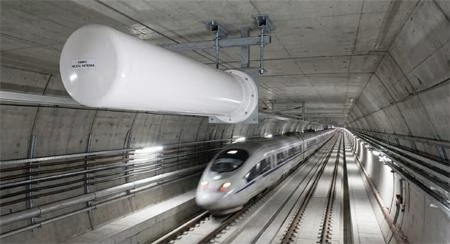
| Indoor/Tunnel | Patch, Ceiling Mount or Helical | Discreet, low-profile coverage for "dead zones." |
3. Prioritize Gain and Efficiency
Gain (measured in dBi or dBd) determines how far your signal can reach.
- For urban environments, a moderate gain is often better to manage multipath interference.
- For rural or long-haul coverage, high-gain antennas (like 10dBi+ fiberglass collinears) are essential to maintain a stable link over vast distances.
- Note: Efficiency is the actual power radiated. An antenna with high gain but poor efficiency (due to bad grounding or materials) will still perform poorly in the field.
4. Evaluate Environmental Durability
Since TETRA is used for critical communication, your antenna must survive where others fail. Look for these "Must-Haves" in technical specifications:
- Wind Loading: Rated for at least 160–200 km/h for tower-mounted units.
- Materials: Marine-grade stainless steel (316) and UV-stabilized fiberglass (radomes) to prevent corrosion and "sun-rotting."
- Lightning Protection: Ensure the antenna is DC-Grounded to protect your expensive radio equipment from static discharge and strikes.
5. Polarization and Radiation Pattern
- Polarization: Most TETRA systems use Vertical Polarization. Ensure your antenna matches the network's orientation to avoid a significant signal loss (up to 20dB).
- Pattern: If you are at the edge of a coverage area, a Directional Yagi can "pull in" a weak signal. If you are in the center of a city, an Omnidirectional pattern ensures 360° connectivity.
Conclusion: Making the Right Call
Choosing the best TETRA antenna is a balance between frequency accuracy, mechanical ruggedness, and gain requirements. Never settle for "typical" specs; for mission-critical work, always demand guaranteed performance across the entire band.