Why Helical Antennas Rule High-Speed Rail Tunnels
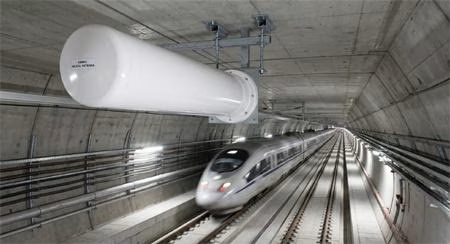
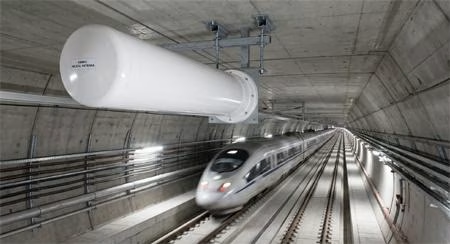
Imagine this: you're zipping through a tunnel at hundreds of miles per hour on a high-speed train, but your movie buffers, your video call drops, and your internet signal is as elusive as a shadow in the dark. Frustrating, right? It's a common problem in tunnels, where standard antennas struggle to maintain a stable and robust signal. But there's a superhero in the world of wireless technology, and it's called the helical antenna.
In this blog post, we'll delve into why helical antennas are the undisputed champions of high-speed rail tunnels. We'll explore their unique design, how they conquer the challenges of tunnel communications, and the incredible benefits they bring to both passengers and train operators. Get ready to discover the secret sauce behind that reliable signal on your next subterranean adventure!
The Tunnel Trap: Why Signals Fail Underground
First, let's understand why tunnels are such a hostile environment for wireless signals. Standard antennas usually radiate signals linearly – either horizontally or vertically. When these signals travel through a tunnel, they face a perfect storm of challenges:
- Signal Bounce Bonanza: Tunnels are like giant, metal-lined echo chambers. Signals bounce off the walls, floor, and ceiling, creating countless reflections.
- The Dreaded Fading: When these reflected signals reach your device, they can arrive slightly out of sync. This results in signal fading, causing your connection to drop or become painfully slow.
- The Doppler Dilemma: High-speed trains are exactly that – fast! As the train moves, it creates a phenomenon called the Doppler effect, which shifts the frequency of the signal. This makes it even harder for your device to maintain a reliable connection.
Enter the Hero: The Circular Helical Antenna
Now, let's introduce our hero, the helical antenna. This fascinating antenna looks a bit like a coiled spring, and this very design is what gives it its superpowers. Unlike standard antennas, helical antennas radiate circularly polarized signals. Think of it as the signal corkscrewing through the air, spinning either clockwise or counter-clockwise.
This circular polarization is a game-changer for tunnel communications. Here's why:
- Beating the Bounce: When a circularly polarized signal reflects off a surface (like a tunnel wall), its polarization reverses. For example, a right-hand circular signal becomes left-hand circular. This is a crucial detail because the helical antenna on your device is designed to receive only the specific polarization it's built for. So, the original signal gets through, while the reversed, reflected signals are ignored. This dramatically reduces signal fading caused by reflections, ensuring a much more stable and reliable connection.
- Conquering the Doppler Shift: The circular polarization of helical antennas is also significantly less affected by the Doppler effect. This means that even as your high-speed train speeds through the tunnel, your device can still receive the signal loud and clear. It's like having a signal that's impervious to the train's speed.
- Powering Up the Signal: Helical antennas are also known for their impressive gain. Think of gain as a magnifying glass for the signal. The helical design concentrates the signal's energy, sending it further and making it stronger. This is vital in long tunnels where signals can weaken over distance.
Real-World Wonders: How Helical Antennas Transform Train Travel
The benefits of helical antennas are not just theoretical; they are delivering tangible advantages in high-speed rail systems around the world. Here are just a few:
- Uninterrupted Connectivity: Passengers can enjoy seamless streaming, video calling, and browsing throughout their tunnel journey. No more buffering, no more dropped calls – just pure, uninterrupted connectivity.
- Enhanced Safety and Efficiency: Train operators rely on constant communication with central control systems for a wide range of functions, including train scheduling, diagnostics, and emergency response. Helical antennas provide a robust communication backbone that is essential for safe and efficient operations.
- Faster Data Speeds: The stable and strong signal provided by helical antennas translates into faster data speeds. This allows for the integration of advanced technologies like real-time video surveillance and on-board passenger information systems.
Conclusion: The Future is Bright (and Well-Connected) with Helical Antennas
As high-speed rail networks continue to expand and train speeds increase, the need for reliable communication in tunnels becomes even more critical. Helical antennas, with their unique design and impressive capabilities, are proving to be the ideal solution for this challenging environment. They are the key to unlocking the full potential of high-speed rail, creating a future where passengers and operators can experience the benefits of seamless connectivity, even in the depths of a tunnel.
So, the next time you're on a high-speed train, speeding through a tunnel with a perfect signal, take a moment to appreciate the unsung hero that makes it all possible – the ingenious circular helical antenna. It's a testament to human innovation and a reminder that even in the darkest of tunnels, a reliable connection can always be found.